> For the complete documentation index, see [llms.txt](https://docs.leadbay.app/doc/llms.txt). Markdown versions of documentation pages are available by appending `.md` to page URLs; this page is available as [Markdown](https://docs.leadbay.app/doc/product-guides/lenses.md).
# Lenses
Lenses are saved filter configurations that define which leads you see. Each lens targets a specific market segment — by sector, location, company size, or keywords.
Lenses also power AI recommendations: the system learns from your likes and wins within each lens to suggest increasingly relevant leads.
***
## Choosing a Lens
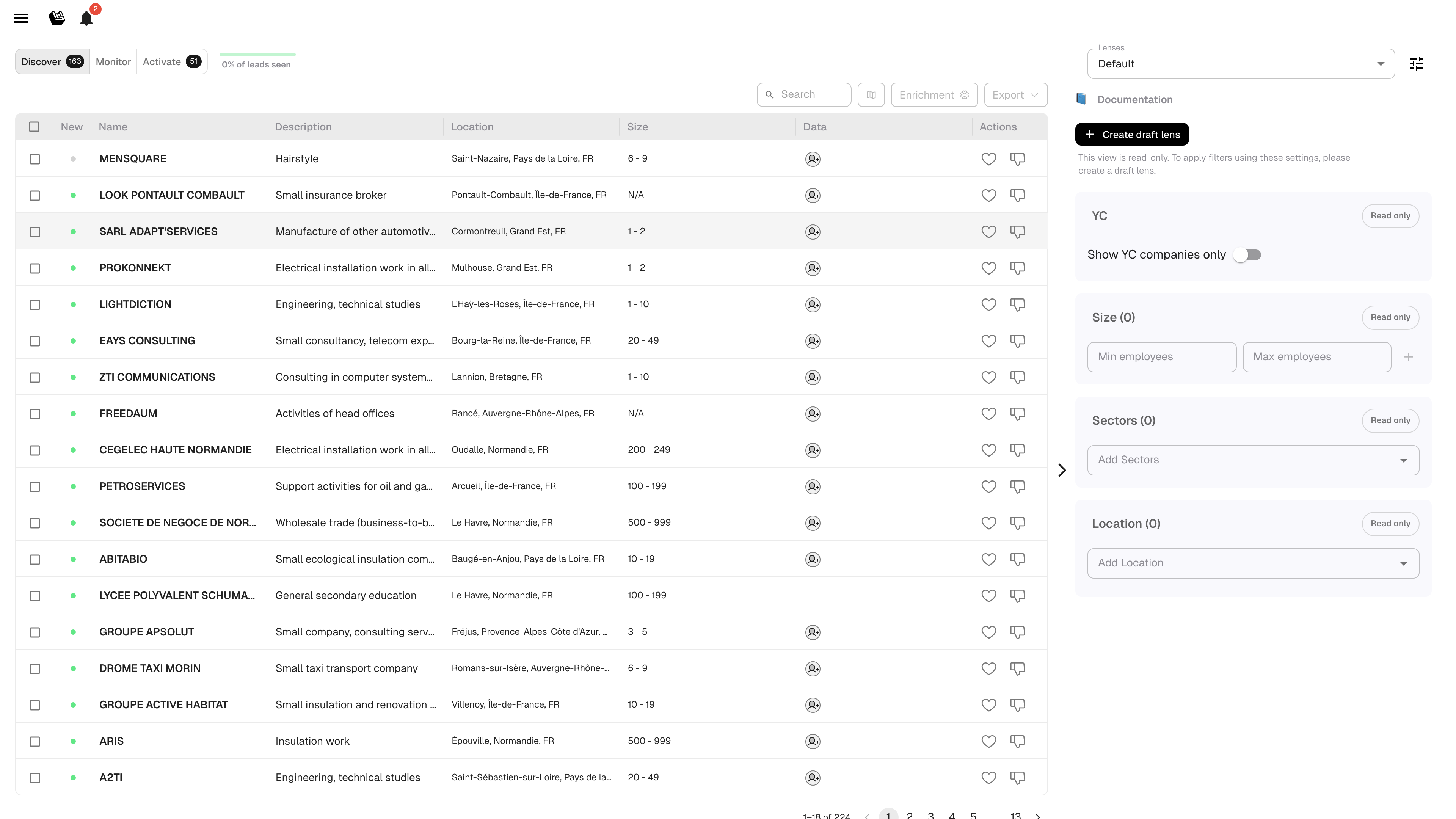
The lens selector appears at the top of the page. Pick a lens from the dropdown to instantly load its filters and recommendations.
Lens selector
Whatever filters you change remain attached to the currently selected lens. Switch lenses and the parameters change with it.
***
## Organization Lenses vs Private Lenses
There are two types of lenses:
| Type | Visibility | Who can edit |
| ----------------------- | ---------------------------- | ------------ |
| **Organization lenses** | Shared with all team members | Admins |
| **Private lenses** | Only visible to you | You |
One organization lens is marked as **Current** (the default lens for the team). You can promote a private lens to an organization lens if you want your team to share it.
***
## Creating and Managing Lenses
Click the lens settings icon (gear) to open the lens management panel.
From here you can:
* **Create a new lens**: type a name and click +
* **Edit** a lens (pencil icon): rename it
* **Delete** a lens (trash icon)
* **Promote** a private lens to organization (arrow up icon)
* **Set as current** organization lens (arrow down icon)
### Draft Lenses
If the current lens is **read-only** (e.g., the default organization lens when you're not an admin), you can click **Create draft lens** to make an editable copy. Adjust filters in your draft, then optionally promote it.
***
## Lens Filters
Filters define which leads match a lens. Anything Leadbay knows about a company can be a filter criteria.
### Available Filter Types
| Filter | Example |
| ------------ | ------------------------------- |
| **Location** | Paris, Lyon, Occitanie |
| **Sector** | Financial Services, Agriculture |
| **Size** | 10–200 employees |
| **Keywords** | SaaS, B2B, renewable energy |
### How Filters Combine
**Within the same filter type** (e.g., multiple sectors): Leadbay uses **OR** logic. A lead matching *any* of the selected sectors qualifies.
**Across different filter types** (e.g., sector + size): Leadbay uses **AND** logic. A lead must match *all* filter types.
**Example:** Sectors = `Financial Services, Agriculture` + Size = `50-100`
* A bank with 75 employees: **matches** (Financial Services AND 50-100)
* A farm with 200 employees: **does not match** (Agriculture but NOT 50-100)
* A tech company with 80 employees: **does not match** (NOT Financial Services or Agriculture)
***
## How Lenses Affect AI Recommendations
Each lens builds its own AI model. The system learns from:
* Leads you **liked** within this lens
* Leads marked as **won** within this lens
* Your **qualification question** answers
The result is a relevance **score (0–99)** for each lead, specific to the active lens. Switch lenses and scores change because the AI model is different.
{% hint style="info" %}
If you sell multiple products to different markets, create one lens per product/segment. This gives each segment its own AI model and recommendations.
{% endhint %}
---
# Agent Instructions
This documentation is published with GitBook. GitBook is the documentation platform designed so that both humans and AI agents can read, navigate, and reason over technical content effectively. Learn more at gitbook.com.
## Querying This Documentation
If you need additional information that is not directly available in this page, you can query the documentation by asking a question.
Perform an HTTP GET request on the following URL with the `ask` and `goal` query parameters:
```
GET https://docs.leadbay.app/doc/product-guides/lenses.md?ask=&goal=
```
`ask` is the immediate question: it should be specific, self-contained, and written in natural language.
`goal` is what the user is ultimately trying to achieve, the reason they need the answer. Sharing it helps GitBook give you a better, more relevant answer. A goal is most helpful when it describes the outcome the user wants rather than restating the question. For example, with `ask=how do I create an API token`, a goal like `automate deployments from our CI pipeline` lets GitBook tailor the answer to that use case.
The response will contain a direct answer to the question and relevant excerpts and sources from the documentation.
Use this mechanism when the answer is not explicitly present in the current page, you need clarification or additional context, or you want to retrieve related documentation sections.